A Letter to the Mothers and Fathers of the World

A Letter to the Mothers and Fathers of the World
On the daughters of Afghanistan, and the silence we have called consent
By Anosha Zereh
Dear mothers and fathers of the world,
I am writing to you this week because I cannot sleep.
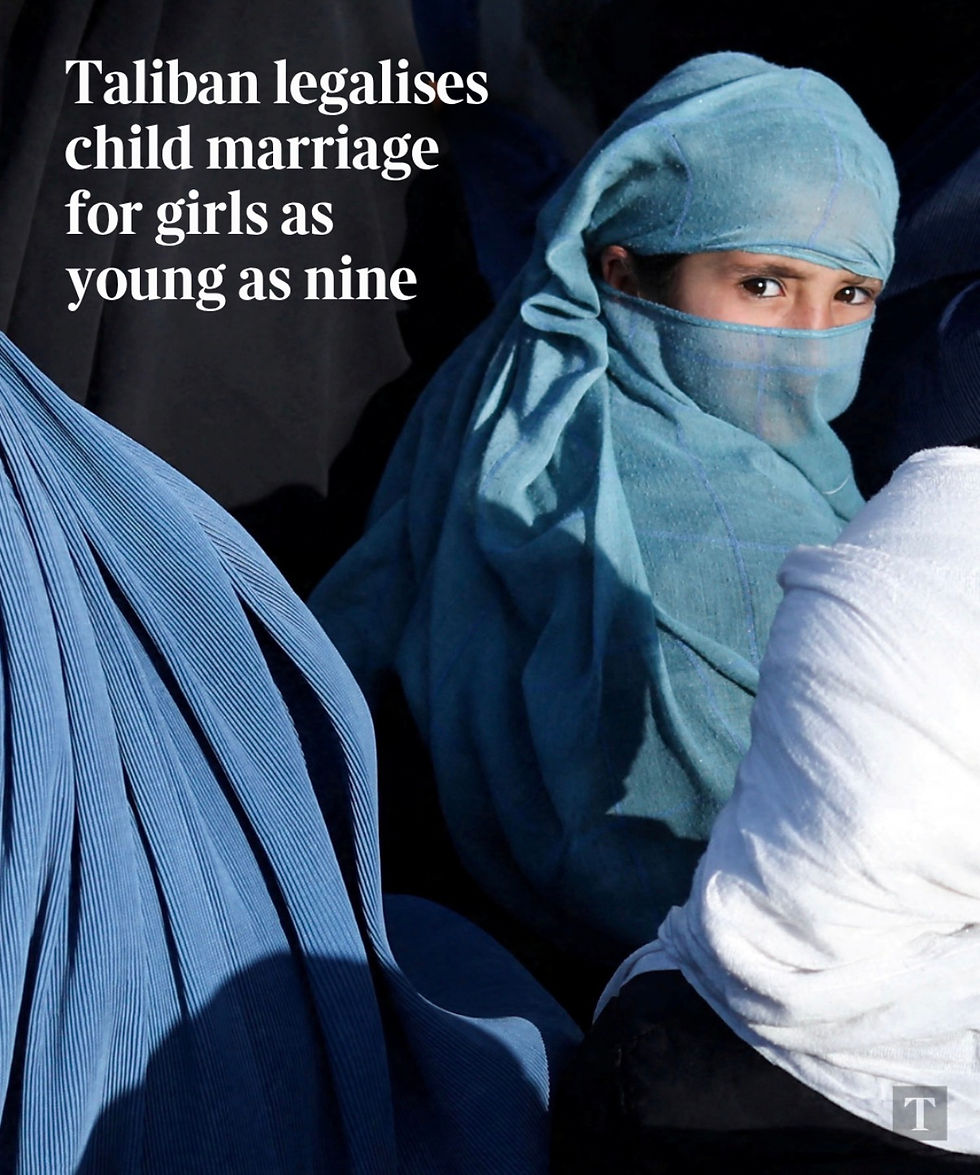
This morning, The Times of London printed a sentence that should have stopped the world: "Taliban legalise child marriage for girls as young as nine." The decree — thirty-one articles called Principles of Separation Between Spouses, signed by the Taliban supreme leader Haibatullah Akhundzada and published this month in the official gazette — removes any minimum age for the marriage of girls by tying eligibility to puberty. As Horia Mosadiq, director of the Conflict Analysis Network, put it plainly: "If a girl reaches puberty at the age of nine or ten, she is considered of a legal age to marry." The same decree declares that the silence of a virgin girl is to be treated as her consent — a rule that does not apply to boys, and does not apply to previously married women. The law also permits rape inside marriage and suggests that a husband's abuse of his wife is not grounds for divorce.
Nine years old. Silence as consent. Rape inside marriage written into law. This is the week of May 2026.

Two days earlier, the BBC ran a piece from Ghor province called "Selling children to survive: Afghan fathers forced to make impossible choices." Perhaps you saw it. Perhaps it played on a screen in your kitchen while you made breakfast for your own children. A father held his seven-year-old twin daughter Rohila in his arms and wept. "I am to sell daughters," he said. "I am impoverished, in debt, and powerless." Another father had already sold his small daughter Shaiqa for about $2,800 to pay for the surgery that saved her life. In five years, when she is ten, she will be taken from his home and called someone's daughter-in-law.
The BBC framed it as a story about poverty. About impossible choices. About fathers with dry lips and empty hands.
And I want to say, gently but without apology, that this framing is a lie of omission. Place the two reports side by side — the famine in Ghor and the gazette in Kabul — and you can see the machine working. One hand creates the hunger. The other hand writes the law that turns the hungry man's daughter into a legal commodity. The girls fall through the middle.
The question almost no one is asking is the only question that matters.

Who is buying these girls?
A five-year-old is not a bride. A nine-year-old is not a wife. A ten-year-old taken into a stranger's house is not a daughter-in-law. On the other side of every one of these transactions is an adult man with money in his hand, walking into a home and walking out with a child he intends to rape. That is the sentence the world keeps refusing to write. So let me write it here, in this letter to you.
These girls are being sold into child rape and sexual slavery. The poverty is real. The hunger is real. The grief of these fathers is real. And none of it changes what is happening to the daughters.
Look at what surrounds these two reports.
In January, the Taliban's Ministry of Education confirmed what had already been true for five years: a permanent ban on girls attending secondary school or university. Around 2.2 million girls are sitting at home as I write this sentence. Afghanistan is the only country on earth where half the population is barred by law from learning to read past the age of twelve.
In 2024, the regime passed a "Law on the Promotion of Virtue and the Prevention of Vice" that made a woman's voice itself "intimate" — she may not sing, recite, or be heard in public. And now, in May, the new decree tells us that her silence is her yes.
Read that one more time. They took her voice.
Then they wrote into law that the absence of the voice they confiscated is her consent. This is not poverty. This is policy. This is design.
The former UN Special Rapporteur on Afghanistan, Richard Bennett, has named this for what it is: gender apartheid, and a crime against humanity under the Rome Statute. Not a tragedy. Not a cultural difference. A crime.
UN Women projects that if these restrictions hold, Afghanistan will see a 25 percent rise in child marriages, a 45 percent increase in teenage pregnancies, and at least a 50 percent surge in maternal deaths. These are not metaphors. These are funerals being scheduled in advance.
And we — the rest of the world — are the second half of the market. In 2025, the United States, once the largest donor to Afghanistan, ended nearly all of its humanitarian aid. The United Kingdom and other major donors slashed theirs. This year's aid is 70 percent below 2025's. Today 4.7 million Afghans stand on the brink of famine; three out of every four cannot meet basic needs. When you withdraw food from a country whose regime has already withdrawn schools, work, voice, movement, and consent from its women — what do you imagine will be sold next?
The buyer at the door is one man. The conditions that put him there were authored by many hands, including ours.
To the fathers in Ghor, in Herat, in Badghis, in every village where a daughter is bargained over tea: I will not pretend to know your hunger. I have wept reading your words.
And still — and still. A daughter is not a kidney. A daughter is not a debt instrument.
When you hand her to a man three or four times her age, you are not saving her. You are transferring her death from one form to another, from starvation to a wedding night she cannot survive.
I say this as a daughter of this region. I was raised in the cadence of the Persian poets, in the Sufi understanding that every soul is a guest of the Beloved, that the body of a child is sacred ground. There is nothing — no debt, no famine, no fatwa, no decree from Kandahar — that overrides the trust placed in a parent's hands when a daughter is born. Nothing.
To the mothers of the world who watched that BBC clip and turned away because it was too much: I understand. I have a body that flinches too. But I am asking you to turn back.
Somewhere in Ghor right now a mother is saying, "All we have is bread and hot water, and not even that." Somewhere a grandmother is wrapping a dead infant in cloth. Somewhere a seven-year-old is being told she will live in another man's house now. Her mother is the one who has to braid her hair that morning.
If you are a mother anywhere in the world, you already know what she is feeling. The distance between her kitchen and yours is a passport, a postcode, an accident of birth. Nothing more.
This is a global responsibility. Not because Afghanistan is far away and pitiable, but because the chain that ends at a nine-year-old's wedding night begins in our newsrooms that won't name what they are seeing, in our parliaments that cut food and call it fiscal discipline, in our living rooms where we change the channel because the truth is too heavy to hold over breakfast.
I am a writer. I do not have an army or a treasury. What I have is this letter, and the language of the poets who raised me, and a refusal to let Rohila and Shaiqa and the unnamed nine-year-old in Kabul become a sentence we scroll past on a Wednesday morning.
A daughter is not a transaction. Not in Ghor. Not in any tongue. Not in any scripture worth the paper it is written on.
And a child's silence is not her yes. It is ours.
With grief, and with a fierce and stubborn hope,
Anosha Zereh
Iqra Publishing House & Media © 2026 Anosha Zereh. All rights reserved. This letter may be shared in full with attribution and a link back to the original post. Republication, adaptation, translation, or commercial use requires written permission from the author at azereh@gmail.com


Comments